Because October is right around the corner, I figured I'd begin counting down my top horror films per decade once more. I wanted to get more done last year but ran out of time. This year, I'm hoping to reach at least the 2000's.
Criteria:
Must be a film produced between 1970 and 1979
Must be a horror film, thriller, or have horror-related subject matter
As always, a little backstory...
The Seventies were a decade, much like the Sixties, of revolution. After the Manson murders in Southern California, the American public was exposed to violence never thought of before. The ensuing media circus surrounding the trial of Charles Manson and his associates prompted a new fixation on cults and serial killers. Soon, the macabre and sick exploits of Jeffrey Dahmer, Son of Sam, Ted Bundy, and John Wayne Gacy became subjects of national interest and analysis. The Vietnam War drew to a close, with many veterans returning home mentally and physically destroyed by the countless horrors they had witnessed, which only strengthened the anti-war movement which grew ever-strong in the country. The deaths of John F. Kennedy, Martin Luther King, Jr., and Malcolm X the previous decade had made those men martyrs in the eyes of their followers, and had spurned an even more radical counter-culture ideology that was adopted by young college and high school students.
These events had the opposite effect on new horror cinema as past events did on old horror. When the Great Depression and World War II hit, people sought movies, especially the fantastical Golden Age horror films, to escape from their real-world troubles. However, now, in this new age of cinema, people went to the cinemas to be faced with troubling questions about the state of the world. New, young filmmakers such as Martin Scorsese, William Friedkin, George Lucas, Steven Spielberg, and Francis Ford Coppola were rising in the film-making world, breaking the rules of Hollywood and producing some critically acclaimed and high-grossing work such as
The Godfather, American Graffiti, The French Connection, Duel, Mean Streets, Taxi Driver, Jaws, and
Star Wars, a lot of which had more violence and moral ambiguity than was allowed in most major studio fare.
Jaws and
Star Wars became the first films that were referred to commonly as "blockbusters," setting a new trend in Hollywood.
On the seedier end of the independent movie scene were young, fledgling directors like Brian De Palma, George A. Romero, Wes Craven, John Carpenter, Dan O'Bannon, Tobe Hooper, and Sean S. Cunningham, These men were lovers of film who were raised (at least mostly) on a diet of Universal monster movies, Hammer horror, Hitchcock, and 50's sci-fi schlock. Taking what they loved about the classic horror genre while adding the brutality and violence so present in Seventies culture made for a potent mix that produced some of the best films ever made. By the end of the decade, Carpenter's
Halloween reinvented the entire horror genre and spurned forth (arguably) its' most popular sub-genre: the slasher film...
The List:
25.
Blacula (1972): This blaxploitation horror film may sound funny on paper, but is actually fairly effective. William Marshall is charismatic in the titular role, and while the plot isn't all that deep, it's pretty good for a cheaply made exploitation movie.

24.
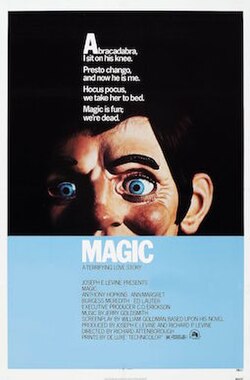
Magic (1978): This psychological horror film further popularized the killer doll genre of movies. While it borrows much from previous "killer ventriloquist dummy" media like episodes of
The Twilight Zone and the film
Dead of Night, it infused a mystery element and was made by a stellar production team: director Richard Attenborough, and a cast featuring Anthony Hopkins, Ann-Margaret, Burgess Meredith, and Ed Lauter elevate this film above the general cheesy killer pupper fare.
23.
Valerie and Her Week of Wonders (1970): This surreal and bizarre Czech film is a twisted fairy tale chronicling a young girl named Valerie's encounters with a thief, a masked monster, and a priest, among other things. A dreamlike film that's almost reminiscent of David Lynch, it packs in some weird and unsettling imagery that sticks with the viewer, and is a great example of an exercise in surrealist horror.

22.
Deathdream (1974): Bob Clark may be best known today for directing
A Christmas Story and
Murder By Decree, but in the 70's, he was an independent horror film director. And a good one, at that. His films were ahead of their time, and dark and brutally violent, and, best of all, genuinely unnerving. This film was a commentary on the Vietnam War's effects on the folks back home, as well as a quasi-adaptation of the W.W. Jacobs short story "The Monkey's Paw".

21.
The Abominable Dr. Phibes (1971): This Vincent Price vehicle came late in his career, but was successful enough to spawn a sequel. A classic revenge story set around the Ten Plagues of Egypt, the film sees Price once again play a disfigured genius driven mad and fueled by vengeful rage. The kills in the film push the boundaries of believability, but are unique and memorable. A campy and often neglected entry in the horror genre, it's one of Price's better films.

20.
Nosferatu the Vampyre (1979): Werner Herzog's artful remake of the 1922 classic silent film stars Klaus Kinski in the titular role. Shot in both English and German, this film continues in the trend of Herzog and Kinski's partnership, it is a vivid and beautiful film to look at, and Kinski is perfect as Nosferatu. Despite the allegations of animal cruelty and abuse on the set, which Herzog apparently neglected, the movie is still an immensely enjoyable revamp (no pun intended), and one of the few remakes that is on par with its' source material.

19.
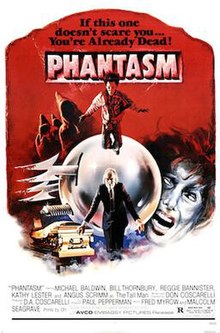
Phantasm (1979): This bizarre and eerie supernatural thriller was a locally financed indie film that wound up spawning a string of sequels, and cementing Angus Scrimm's Tall Man character as an icon of the horror genre. With some nightmarish visuals, unconventional structure, and an imposing boogeyman figure as the villain,
Phantasm is one of the more underrated 70's horror films.
18.
The Brood (1979): David Cronenberg's body horror film serves as a metaphor for feminine empowerment gone awry and as an interesting look at messy divorces, and asks an interesting question: if we could actually manifest those negative emotions we feel towards others, could it wind up controlling us? The shocking and cringe-inducing imagery and nasty special effects paired with those messages part of what Cronenberg does so well: make us think, and make us squirm, often at the same time.

17.
Alice, Sweet Alice (1976): Featuring Brooke Shields in her film debut, this slasher film is a cut above the rest. This mostly owes to the exceptionally creepy and haunting mask worn by the killer, a translucent mask highlighted with drag queen-esque makeup. The film was released three times under three different titles: as
Communion at the Chicago International Film Festival in 1976, theatrically in 1978 under this title, and a third time in 1981 as
Holy Terror to capitalize on Brooke Shields' growing popularity. While borrowing from many previous films, most notably the raincoat motif from
Don't Look Now, this movie stands on its' own as one of the more genuinely scary of the slasher films, and one that predates
Halloween. And speaking of
Don't Look Now...

16.
Don't Look Now (1973): A startling thriller about psychic powers, serial killers, and ghost girls, the film, much like many 70's horror films, took elements that made old horror films so great, updated them for modern adult audiences, and were being made by some bigger names in the film industry. This one stars Donald Sutherland and Julie Christie, two major stars, and was directed by the acclaimed Nicolas Roeg. This movie has some visually striking images, and one of the best (and most unexpected) twist endings ever.

15.
Black Christmas (1974): Bob Clark shows up again on this list with his dark precursor to
A Christmas Story. A brutal and dreamlike film with a mysterious killer, it set a trend for slasher films, and reportedly this was one of the films that inspired John Carpenter's
Halloween, as the planned sequel for this film would have taken place on that holiday. The camera angles, opening shot, and violent kills set the stage for
Halloween, though this film is even darker, bloodier and more vulgar than that film was. The film has future stars like Olivia Hussey, Andrea Martin, Margot Kidder, and John Saxon, and
2001 star Keir Dullea. The unsolved identity of the killer makes the film unsettling as it leaves so many doors open, and the killer's weird, gender-neutral voice is chilling and sticks in your head.

14.
The Hills Have Eyes (1977): Wes Craven's second major horror movie was stars future
E.T. star Dee Wallace and is a brutal and unapologetic film that chronicles one family's struggle for survival against an inbred family of feral cannibals. Michael Berryman (the man on the poster) was shot to B-movie stardom for his unique physical appearance and imposing performance. The film was successful enough to spawn a sequel and a remake and its' sequel. The movie also further popularized the 70's sub-genre of middle-America family vs. group of deranged killers, and also popularized the feral cannibal sub-genre.

13.
Invasion of the Body Snatchers (1978): This remake of the 1950's classic by Philip Kaufman stars Donald Sutherland, Leonard Nimoy, Brooke Adams,Veronica Cartwright, and Jeff Goldblum. Managing to be just as memorable as the original in its' own way, with surreal, 70's acid-trip imagery and a harrowing twist ending, this movie also has a much more graphic and nasty pod people transformation process and the logic behind the transformations is actually an improvement over the original, which had a plot hole in that area. While not as iconic or important as the original, this reimagining is definitely one of the best remakes of all time.

12.
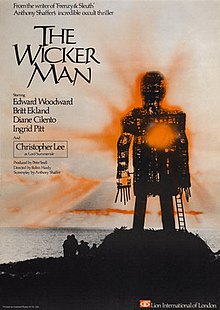
The Wicker Man (1973): This dark occult mystery film pits a devoutly Christian police detective against an underground pagan cult. Christopher Lee's performance as the villain Lord Summersisle is one of his more underrated, and the cast, featuring Edward Woodward, Ingrid Pitt, Diane Cilento, and Britt Ekland. It has some great suspense, an interesting soundtrack, a compelling mystery that slowly spirals into a much larger conspiracy, and has a fantastic and horrific ending reveal. The hilarious 2006 remake starring Nicolas Cage is only entertaining on an ironic level, and can't hold a candle to the original.
11.
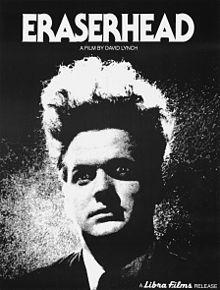
Eraserhead (1977): David Lynch's first feature is one of the most nightmarish and stomach-churning movies ever made. The bizarre and uniquely nasty imagery, industrial location and soundtrack, dreamlike narrative, and creepy and odd characters set the standard for Lynch films: symbolic and weird movies that creep under your skin.
10.
The Last House on the Left (1972): A brutal and sickening revenge thriller, produced by Sean S. Cunningham and directed by Wes Craven in his debut film, the movie serves a warning about the consequences of revenge. Reflecting the horrific side of the Love Generations showcased by the Manson murders, this grindhouse exploitation film features some of the most brutal violence seen at the time. The violence was enough to get it banned in several countries and cause a lot of controversy upon release. But it is this violence that assaults the viewer and makes them ponder the consequences of it in the real world. Many people mistake this movie for glorifying or sexualizing violence, when it is doing the exact opposite, it is a warning against violence, unlike the 2009 remake, which ends on a slightly happy note and glorifies the revenge sequence at the end of the film as justified.

9.
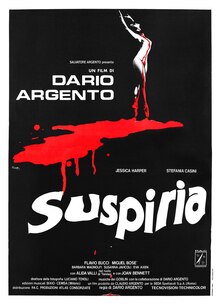
Suspiria (1977): Dario Argento's stylish Italian giallo movie is one of the most beautiful and colorful horror films to look at. Part of his "Three Mothers" trilogy, this movie is famous for its' beautiful cinematography, vivid color palates, and almost fairy tale-esque plot. The score by prog-rock band Goblin is excellent, and set a trend for prog-rock and synth bands composing scores for horror and sci-fi films during the 1980's.
8.
Carrie (1976): Based on Stephen King's bestselling 1974 novel, Brian DePalma's masterful adaptation darkened the ending and provided some great cinematography and suspenseful sequences. The climactic dance scene is taut and has the viewer on the edge of their seat, until the moment when all hell breaks loose and Carrie has her brutal revenge on all those who wronged her (and some who didn't). Sissy Spacek and Piper Laurie both had Oscar-nominated performances, Spacek for her role as the timid and emotionally troubled teenage girl, and Laurie as her psychotic and domineering Christian mother. Nancy Allen and John Travolta also appear in the film, another case of future A-listers appearing in smaller projects. The relationship between Carrie and her mother is tragic, symbiotic, and cringe-worthy to watch, and is the dramatic backbone of the movie. The first Stephen King movie adaptation was also based on his first novel, and kick-started a string of over 100 adaptations of his various works.

7.
The Omen (1976): Richard Donner and David Seltzer's Satanic thriller has a moody and atmospheric score, great lead performances by Gregory Peck, Lee Remick, and David Warner, and one of the best "creepy kid" performances by Harvey Spencer Stephens. The mystery surrounding the boy continues to unravel in unexpected ways, and the film masterfully builds to a crescendo where our leads desperately try to stop the horrible force that is Damien. However, unlike
The Exorcist,
The Omen leaves an a much more ominous and foreboding ending, with no comforting happy ending to be had.

6.
Alien (1979): Dan O'Bannon's script and Ridley Scott's eye of visuals combine to create the greatest of the sci-fi horror movies. H.R. Giger's phallic and iconic creature design and disturbing art style contribute to much of the film's look. The lead performances by Sigourney Weaver, John Hurt, Tom Skerritt, Veronica Cartwright, and Henry Dean Stanton are phenomenal, particularly Weaver's turn as Ellen Ripley, one of the most bad-ass female leads of all time. The effective use of long tracking shots, false scares, and long periods of suspense and build-up make
Alien just as much a Gothic horror/slasher film as it is a sci-fi thriller. And although it borrows a lot from the 1950's film
It! The Terror from Beyond Space, it also contributed enough original visuals and scares (chest-burster scene) to be its' own film.

5.
Dawn of the Dead (1978): George A. Romero's follow-up to his 1968
Night of the Living Dead is is color and cranks up the gore and returns to his social commentary. Instead of being about race relations, it's about mall culture turning Americans into zombies. The leads, including Ken Foree, are great and the set-pieces, especially the final sequence where the survivors must face off against both a biker gang and a horde of incoming zombies is spectacular. It surpasses the original in every conceivable way, and although it has a happier ending (the original cut of the film had a much more somber end), it is a darker film than its' predecessor. It also has one of the best lines/taglines in horror history: "When there's no more room in Hell, the dead walk the Earth."

4.
The Texas Chain Saw Massacre (1974): Made on a shoe-string budget with a cast of unknowns (mostly Texas natives), Tobe Hooper's grimy and nasty grindhouse film introduced the world to slasher icon Leatherface and his family of deranged cannibals. A film that remains discomforting today due to its' improvised, documentary-style feel and savage violence (most of which is off-screen and implied, leaving it to the viewers' imagination), it also inspired many modern filmmakers, including Peter Jackson, and was a forerunner of the slasher genre. Gunnar Hansen remains the best Leatherface, mostly due to his convincing portrayal that doesn't make him totally sympathetic like the remake tries, but also reminds us that he, too, is human and has good traits (cares for his family's well-being), but also constantly reminds us that he is a force to be reckoned with. His mask seems more authentic than the remake's as well, further creating this weird blurring-the-lines effect where one can't be sure what they are seeing is staged or not. The other actors, including Ed Neal, are so good at portraying demented killers that one could almost be convinced Hooper just cast real crazy people in his movie.

3.
Jaws (1975): Steven Spielberg's innovative blockbuster film faced numerous production problems, resulting in a malfunctioning mechanical shark on set. Due to this, the shark was used more sparingly than Spielberg had hoped, but this led to the team mostly using POV shots of the shark, and because the shark only appeared on screen briefly once in a while, it built up incredible suspense to when it would next appear. With John Williams' iconic and slow-building main theme scoring the film and some great performances by Roy Scheider, Richard Dreyfuss, and Robert Shaw (especially Shaw, who plays the memorable Quint, who gives a chilling monologue about shark eyes), this adventure-thriller based on Peter Benchley's novel remains one of the top 20 films ever made.

2.
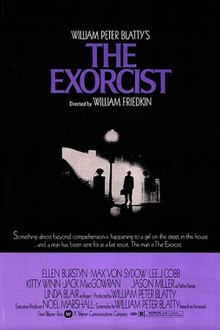
The Exorcist (1973): William Friedkin's adaptation of William Peter Blatty's demonic possession horror novel (which in turn was based of a reportedly true story) caused mass waves of controversy upon release. Christian groups claimed it was possessed by Lucifer himself, while most of the general public ran screaming from the theater upon seeing it. The special effects by Dick Smith were revolutionary and still look convincing today. The vulgar language, disgusting imagery, and frightening voice of Mercedes McCambridge as possessed Reagan are what make the film so memorable and terrifying to this day. It was the first horror film nominated for Best Picture at the Oscars, and it is led by a stellar cast, featuring Ellen Burstyn, Linda Blair (doing a great performance for a child actress), Jason Miller, Lee J. Cobb, and Max Von Sydow (playing a character decades older than he actually was). The main theme from the album
Tubular Bells is up there with John Carpenter's
Halloween score as one of the eeriest and most ear-wormy movie themes of all time.
1.
Halloween (1978): John Carpenter's classic slasher film introduced the world to the first of the modern boogeymen (Michael Myers) and really defined the tropes of the slasher genre. It was followed by a slew of copycat films, and shot Jamie Lee Curtis (daughter of Janet Leigh) to stardom and set her "scream queen" status. The musical score, pacing, POV and tracking shots, and performances by Curtis, Donald Pleasance, and stuntman Nick Castle. The lack of gore demonstrates a great amount of restraint on Carpenter's part, and the shoestring budget was made back a hundred-fold by box office revenue and a consistent word-of-mouth campaign. It is undoubtedly the most influential of the 1970's horror films and the best slasher movie of all time.

Runner-ups:
Vampire Circus, Martin, The Vampire Lovers, Daughters of Darkness, Straw Dogs, I Spit on Your Grave, House (1977), Piranha!, Legend of the 7 Golden Vampires, Tourist Trap.


